

 英语
英语 西班牙语
西班牙语A chair once bought mainly for a weekend at the beach now shows up at music festivals, sideline sports games, backyard gatherings, and roadside campsites within the same season. The Portable Folding Leisure Chair category has grown well beyond its original positioning as beach-specific seating, and that shift in where and how people actually use the product is reshaping which features distributors ask for when they source a new season's lineup.
From a Single Setting to Several
Beach chairs historically prioritized one condition above all others: sand and sun exposure near water. A modern Portable Folding Leisure Chair now needs to perform reasonably across grass, gravel, pavement, and uneven camping terrain, since retail buyers are stocking the same general chair category for customers who might not visit a beach at all. This broader use pattern has pushed product developers to think about base stability and ground clearance on a Portable Folding Leisure Chair as general-purpose requirements rather than beach-specific ones, since a chair that only sits well on soft sand can behave differently once it lands on packed dirt or a paved patio.
Reclining Range Has Become a Comparison Point Across Use Cases
Buyers evaluating a multi-position beach chair for a mixed retail lineup often compare how many recline settings a model offers, since festival and sideline customers tend to want more upright, social seating positions while beach and pool customers still lean toward a flatter lounging angle. A single adjustable frame that covers both ends of that range can serve a wider retail assortment of a Portable Folding Leisure Chair line than a chair locked into one fixed recline angle, which is part of why adjustable positioning has moved from a premium feature toward something closer to a standard expectation across several price tiers.
Accessory Integration Reflects How the Chair Is Actually Used
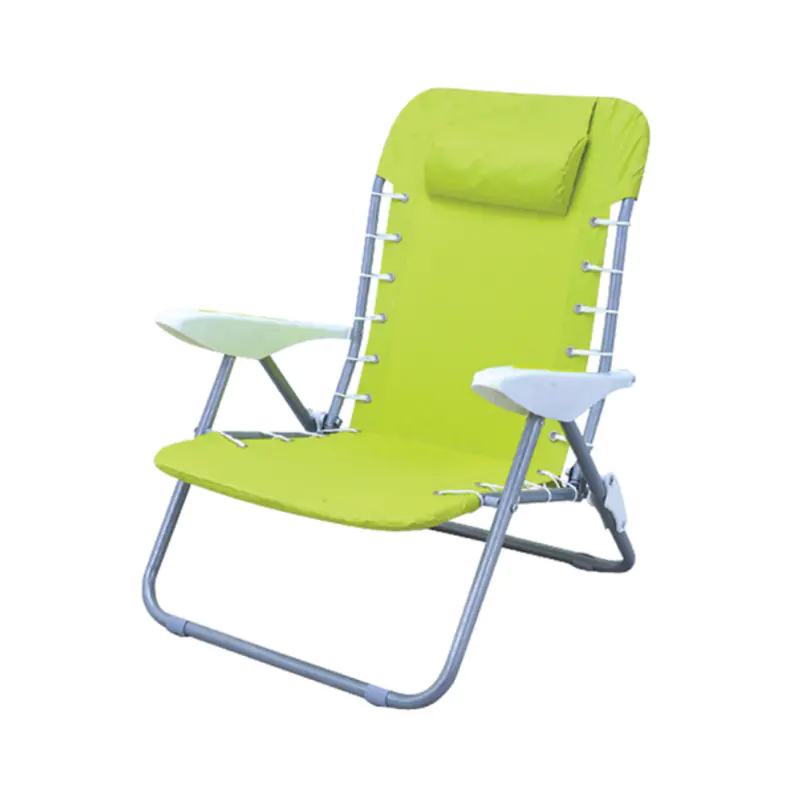
Camping chair accessories such as integrated cup holders, side pockets, and small attached tables have become common enough that their absence is now noticeable to buyers stocking for camping and tailgate-focused retail channels. These additions trace directly back to how people use a folding chair away from a beach setting, where a flat sandy surface is no longer available to set down a drink or a phone. Product developers working on new chair variants often treat accessory placement as part of the core design brief rather than an optional add-on considered late in development.
Portability Requirements Vary More Than They Used To
A chair carried a short distance from a car to a beach blanket has different portability requirements than one carried across a festival field or up a hiking trail to a campsite. Foldable leisure seating aimed at these more demanding transport scenarios tends to emphasize carry bag design, strap placement, and overall folded profile more heavily than earlier beach-chair generations did, where a simple over-the-shoulder strap was generally considered sufficient. Buyers sourcing a Portable Folding Leisure Chair for outdoor retail or camping-focused channels can compare carry method and folded dimensions alongside weight, since two chairs with a similar weight figure can still differ meaningfully in how comfortably they travel over longer distances.
Canopy and Shade Features Extend Into Non-Beach Settings
Built-in canopies, once associated almost exclusively with beach and pool use, are appearing on chairs positioned for general outdoor leisure and camping as well, reflecting how shade has become a feature customers expect across settings rather than one tied to a specific location. An outdoor recliner chair with a removable or adjustable canopy gives retail buyers flexibility to market the same base product across both beach-specific and general outdoor leisure categories without needing entirely separate product lines for each.
Product Development Across a Wider Range of Settings
As the underlying use cases for a Portable Folding Leisure Chair continue to diversify, product developers are increasingly designing around a broader set of conditions from the start rather than adapting a beach-specific design after the fact. Zhejiang Dingge Industry Co., Ltd. develops chair variants across this expanding range of settings, working from customer input on frame configuration, accessory placement, and fabric choice to match how a given retail channel expects the product to be used. This kind of cross-setting development work has become a more regular part of how new chair models get planned, since fewer buyers today are sourcing a single-purpose beach chair in isolation from the broader leisure seating category it now belongs to.