

 英语
英语 西班牙语
西班牙语A folding chair looks simple when opened at a campsite or beside a fishing platform. Most people only notice whether it feels stable, lightweight, or easy to carry.
Inside furniture factories, however, producing a reliable portable folding leisure chair involves much more precision than the finished product suggests.
Unlike ordinary fixed seating, folding structures contain moving joints, load-bearing pivot points, fabric tension areas, and repeated mechanical movement. Small production inaccuracies that seem unimportant during assembly often become obvious after months of real outdoor use.
That is why manufacturers usually spend more time controlling structural consistency than appearance alone.
Frame Material Selection Happens Early
The production process for a portable folding leisure chair usually begins with frame material selection.
Different markets expect different weight and durability balance. Steel frames remain common for higher load capacity, while aluminum structures are preferred when portability matters more than maximum strength.
Tube thickness also changes depending on the chair design.
A lightweight outdoor chair designed for short-term travel may use thinner wall tubing than a heavy-duty camping model intended for long sitting periods. Factories therefore calculate both carrying weight and stress distribution before large-scale production begins.
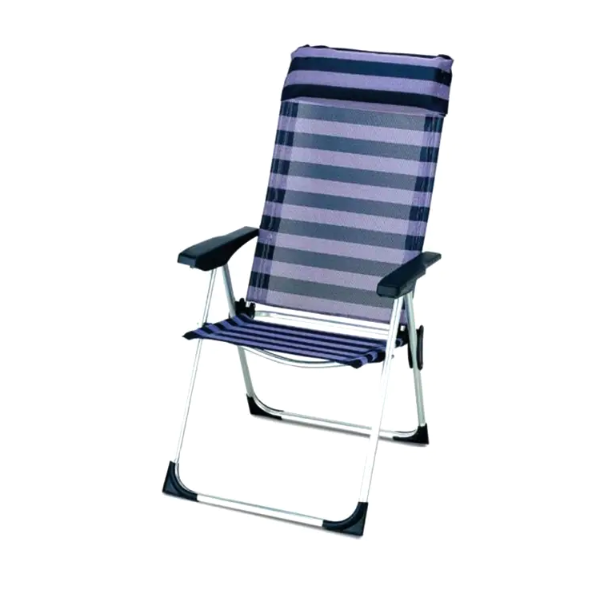
Actually, reducing weight without creating frame instability is one of the more difficult parts of folding chair manufacturing.
Tube Cutting And Bending Affect Stability
After raw materials arrive, metal tubes move into cutting and bending stages.
For a portable folding leisure chair, tube angle precision matters heavily because folding structures depend on symmetrical movement during opening and closing. Even small bending variation may later create uneven ground contact or unstable frame pressure.
Factories normally use automated bending equipment for consistency, especially around curved support sections near the armrest or back frame.
Once bending finishes, frame sections are drilled for hinge installation and connection hardware.
At this stage, dimensional accuracy becomes extremely important because multiple moving sections must align correctly during final assembly.
Hinge Areas Receive More Attention Than Expected
In many folding chairs, the hinge system quietly determines how long the product survives real outdoor use.
A portable folding leisure chair may look strong externally while still failing early if the pivot structure wears too quickly. The repeated opening movement gradually creates stress around connection points, especially if metal friction increases over time.
This is why factories often reinforce:
- cross-joint sections
- rivet positions
- folding locks
- support brackets
- moving contact points
The chair frame itself usually remains stable longer than the hinge system.
For manufacturers, balancing smooth folding movement with structural durability becomes one of the main production challenges.
Fabric Cutting Is Not Just Decorative
After frame production, the seating fabric enters manufacturing.
For a portable folding leisure chair, fabric tension directly affects sitting comfort and long-term stability. If the fabric stretches too easily, the seating surface gradually sags after repeated use. If tension becomes too tight, stress around stitching points increases quickly.
Outdoor chair factories therefore pay close attention to fabric density and sewing reinforcement.
Materials commonly used include polyester, Oxford cloth, mesh fabric, and coated outdoor textiles depending on the target market.
Actually, stitching quality often affects product lifespan more directly than fabric thickness itself.
Weak seams usually fail earlier than the fabric surface.
Surface Coating Protects Outdoor Durability
Most portable folding leisure chair products are designed for outdoor environments, so frame coating becomes an important production stage.
Metal surfaces are cleaned first to remove oil and oxidation before entering coating treatment. Powder coating is widely used because it provides relatively stable outdoor resistance while maintaining smooth appearance.
During long-term outdoor use, lower-quality coatings usually fail first around folding sections where friction happens continuously.
Factories therefore test coating adhesion carefully near moving areas instead of only flat frame surfaces.
This becomes especially important in humid or coastal environments where corrosion risk increases significantly.
Assembly Requires Repeated Movement Testing
Once the frame, fabric, and hardware are prepared, the portable folding leisure chair enters final assembly.
At this stage, workers repeatedly open and close the structure to check movement consistency. Chairs that feel smooth initially may still reveal instability after several folding cycles.
Some factories specifically test:
- opening resistance
- folding alignment
- frame wobbling
- fabric tension balance
- locking stability
Outdoor furniture buyers usually notice these details immediately during real use, even if they cannot identify the technical cause directly.
A chair that opens unevenly or shifts slightly under weight quickly feels lower quality.
Portability Changed Chair Design Direction
In earlier furniture production, outdoor chairs often focused mainly on strength.
Modern portable folding leisure chair development increasingly emphasizes transport convenience as well. Carry bags, lightweight frames, compact folding geometry, and quick-opening mechanisms now influence product design heavily.
Actually, many users care more about how easily the chair fits inside a vehicle or storage area than about maximum weight capacity numbers.
Because of that, factories now balance portability and durability much more carefully than before.
The chair needs to survive outdoor use while still remaining practical to carry repeatedly during travel, fishing, camping, or temporary leisure activities.
For manufacturers, achieving both goals at the same time is where most of the real production difficulty appears.